
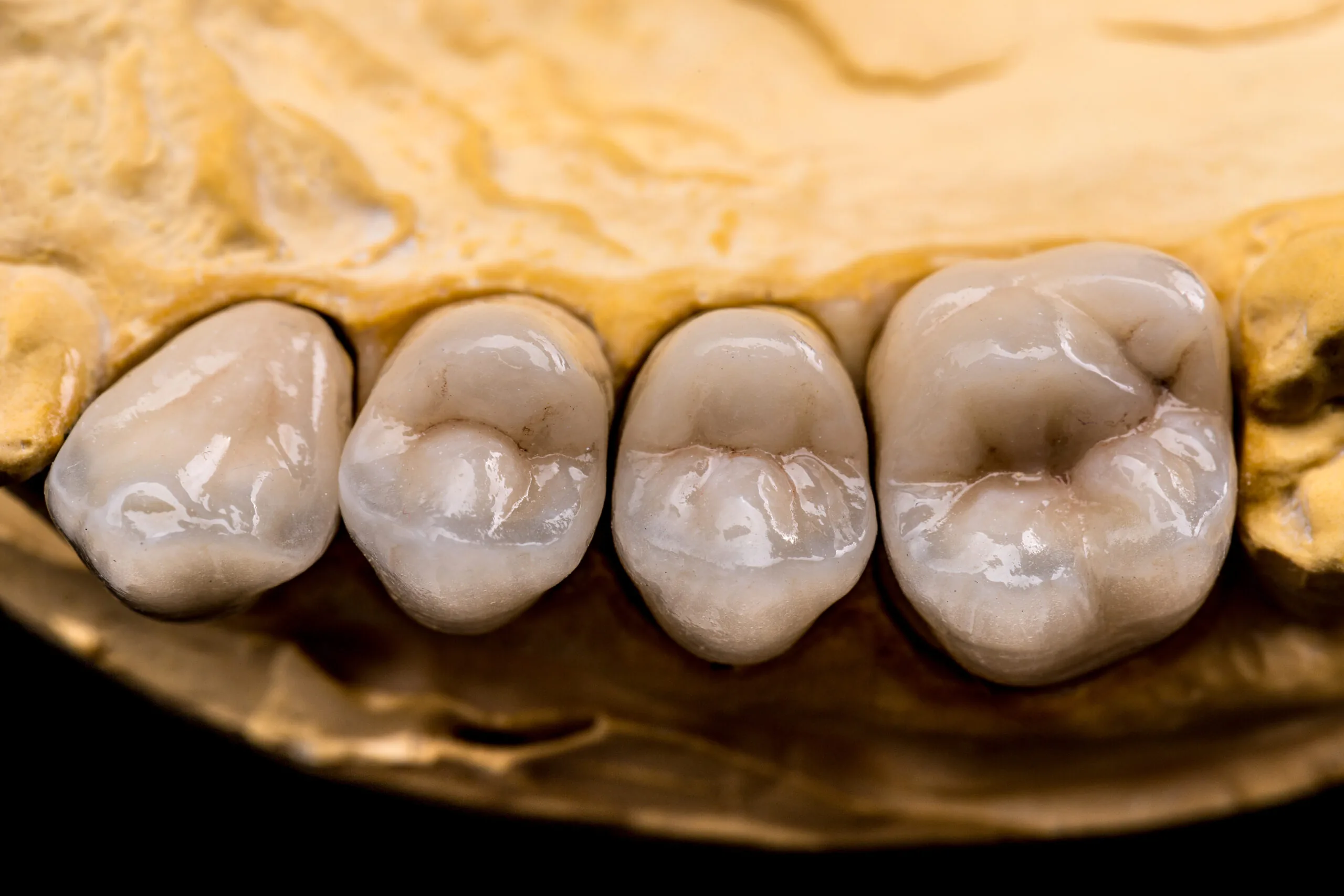
Modern dentistry strives not just to "patch" teeth, but to restore them so they look and function as naturally as possible. While previously most damage was treated with conventional fillings, today patients are increasingly choosing ceramic inlays—high-precision and durable micro-prostheses that restore the tooth's anatomical shape, strength, and aesthetics with minimal compromise. At VEDA STOM, these structures are manufactured using digital technology and custom modeling, ensuring a precise fit and patient comfort.
What are ceramic inlays and how are they different from fillings?
A ceramic inlay is a microprosthetic that serves as an ideal replacement for a missing tooth. Unlike a conventional filling, an inlay is not molded directly in the mouth. Instead, it is created in a laboratory using a precise impression or digital scan, ensuring a highly accurate fit, secure retention, and a natural appearance.
A filling is always limited by the strength of the composite material and the dentist's ability to shape it manually in the oral cavity. An inlay, on the other hand, is created in controlled laboratory conditions, allowing for the formation of all the anatomical elements of the tooth: cusps, grooves, contact points, and even surface texture. This allows an inlay to restore not only aesthetics but also full chewing function.
When ceramic inlays are the best solution
Inlays are not suitable for all cases, but there are situations in which they are significantly superior to conventional fillings:
- when the tooth decay is too extensive and the filling will not be able to support the load;
- if it is necessary to restore a chewing tooth that is under constant pressure;
- when it is necessary to precisely restore the contact surfaces between teeth;
- when the patient expects a result that is as close as possible to natural anatomy;
- in cases of recurrent caries under an old filling that require a more permanent solution.
Thus, an inlay is the choice for those who want a durable, anatomically correct and aesthetically predictable restoration.
The benefits of ceramic inlays: why they last longer and look more natural
1. High strength and load resistance
Ceramic is significantly stronger than the composite used in fillings. It withstands intense chewing forces, does not wear out, and does not change shape, making the inlay a stable component of the tooth for a long time.
2. Perfect fit thanks to digital modeling
Digital scanning allows for a precise model of the tooth, ensuring the inlay is as uniform and tightly fitting as possible. This precision reduces the risk of secondary caries, which often develops under fillings.
3. Aesthetics at the level of “natural teeth”
Ceramics precisely match the shade and translucency of enamel, making the inlay invisible even in bright light. This is important not only for anterior teeth but also for posterior teeth, where aesthetics also play a significant role.
4. Color stability
Ceramics do not absorb dyes and do not darken over time, unlike composite materials, which can change color due to drinks, food or smoking, and are also subject to polymerization shrinkage.
5. Preservation of the maximum amount of natural tooth tissue
Inlays allow for gentle treatment of the tooth while preserving healthy tissue. This makes treatment more gentle and increases the lifespan of the tooth by preserving its natural structure.
How Ceramic Inlays Are Made: A Modern Digital Process
Creating a tab is a complex and highly precise process that involves several stages and requires careful attention at each one.
1. Diagnostics and planning
The dentist assesses the condition of the tooth, the extent of damage, and determines whether an inlay is suitable. If the tooth can be restored this way, preparation begins.
2. Tooth preparation
Damaged tissue is removed, and a cavity of the correct geometry is created to ensure secure fixation of the inlay. This is done with extreme care to preserve as much healthy enamel as possible.
3. Digital impression or scanning
Using an intraoral scanner, a 3D model of the tooth is created. This highly accurate data is then transmitted to the laboratory for fabrication of the inlay.
4. CAD/CAM modeling and manufacturing of the inlay
A dental technician creates a virtual model of the future inlay, taking into account the anatomy of the teeth. The structure is then manufactured from a durable ceramic blank using milling equipment.
5. Fitting and fixing
The finished inlay is tried on in the oral cavity, adjusted if necessary, and fixed with a special cement that ensures a secure connection with the tooth tissue.
What's the difference between a dental inlay and a filling? Key differences for the patient
Understanding the differences helps the patient make an informed choice:
- The filling is formed manually, the tab is created in the laboratory with high precision.
- The filling may become deformed over time., the inlay retains its shape due to the strength of the ceramic.
- The filling is more prone to chipping, the tab can withstand heavy loads.
- The filling gradually darkens, the tab maintains a stable color.
- A filling often does not completely restore the anatomy of a tooth., the tab completely replicates the natural structure.
For chewing teeth, the choice of an inlay is especially justified, since it ensures durability and full functionality.
Why ceramic inlays should be installed at VEDA STOM
The quality of an inlay depends on the diagnosis, manufacturing technology, and the doctor's expertise. VEDA STOM Clinic adheres to international standards of orthopedic treatment, ensuring patients receive durable and aesthetically pleasing restorations.
The clinic's advantages include:
- modern digital equipment;
- accurate diagnosis before treatment;
- individual inlay modeling;
- use of high-quality ceramic materials;
- careful attention to the patient's anatomy;
- step-by-step quality control from diagnostics to recording.
Thanks to this, the inlay becomes not just an “artificial part”, but a functional extension of the natural tooth.
Ceramic inlays are a modern, aesthetic, and durable solution for restoring damaged teeth. They provide maximum bite precision, high strength, and a natural appearance, significantly outperforming traditional fillings.
At VEDA STOM, inlays are manufactured using digital technology and a personalized approach, allowing us to create restorations that look natural, function reliably, and last for years.